Exploring binding and fusion mechanism of SARS-CoV-2 spike glycoprotein using molecular dynamics simulations
Active project
Abstract
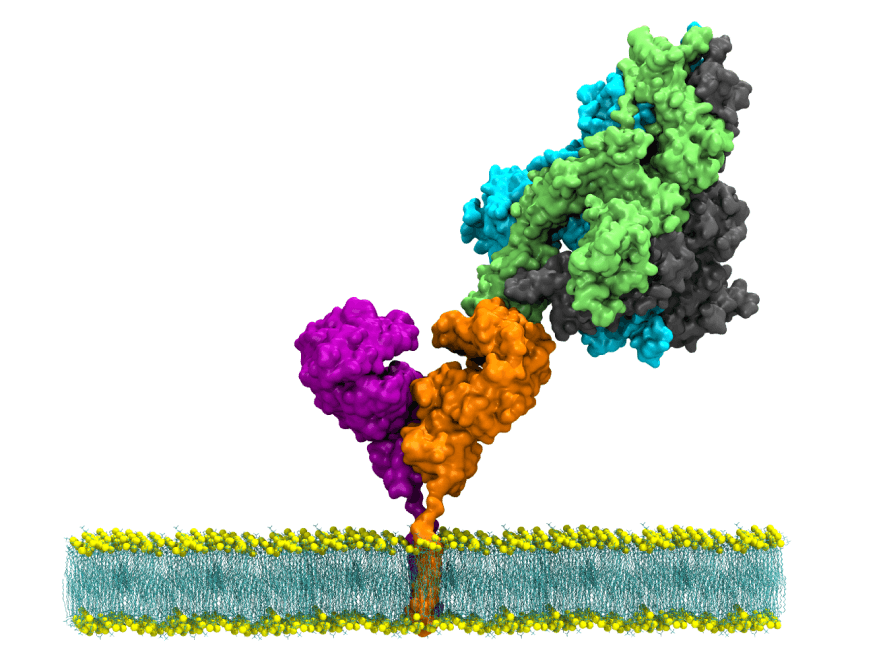
Since its first recorded appearance in December 2019, a novel coronavirus named severe acute respiratory syndrome coronavirus 2 (SARS-CoV-2) has resulted in more than 776,000 infections and 37,000 deaths. SARS-CoV-2 has a viral envelope formed of the lipid bilayer and three structural proteins embedded in the viral envelope, as it is for other coronaviruses: membrane (M), envelope (E) and spike (S). Among them, S proteins provide (i) host cell recognition and (ii) fusion of the host cell with the SARS-CoV-2 membrane. SARS-CoV-2 S proteins target human epithelial and respiratory cell angiotensin-converting enzyme 2 (ACE2) receptors on the cell membrane. As recognition of host cell and entry of the virus are the most critical steps in pathogenesis and viral infectivity, S proteins have emerged as a promising therapeutic antiviral target. Host cell recognition and entry of the virus is facilitated through the pre to post fusion transition of the S protein. Conformational transition This extensive conformational transition is accompanied and coordinated by receptor binding, protein cleavage and interactions with host membrane. Stopping this conformational transition at any point would prevent virus entry into the host cells. Current studies (mostly available in BioRxiv) are focusing on the S protein ACE2 binding interface. However, blocking cleavage sites and inhibiting domain-domain interactions have the potential to serve as promising therapeutic strategies. In order to access the feasibility of these two strategies, first to complete pre to post transition mechanism of the S protein needs to be explored at all-atom resolution. Molecular dynamics (MD) simulations is an excellent tool to address this issue. However, to perform MD simulations of this extent at a short time window requires access to special computing systems and allocations. Here we are proposing a systematic analysis of the transition mechanism by modelling each step of the transition mechanism (receptor binding, cleavage, and membrane interactions) via all –atom MD simulations. To the best of our knowledge, binding and fusion process using the complete S protein structures has not been modeled at an all-atom level using MD simulations yet. Successful completion of our proposed MD simulations will provide crucial information regarding the accessibility of the critical cleavage site and S protein surface during the pre- to post-fusion transition of S protein. Furthermore, our study will provide crucial insight regarding the chemical, dynamical and structural properties of cleavage site and domain interface that candidate therapeutic molecules would need to complement for high affinity binding.
Results (0)
PI
Ahmet Yildiz; University of California, Berkeley