Determining the contribution of glycosylation to SARS-CoV-2 S-protein conformational dynamics
Active project
Abstract
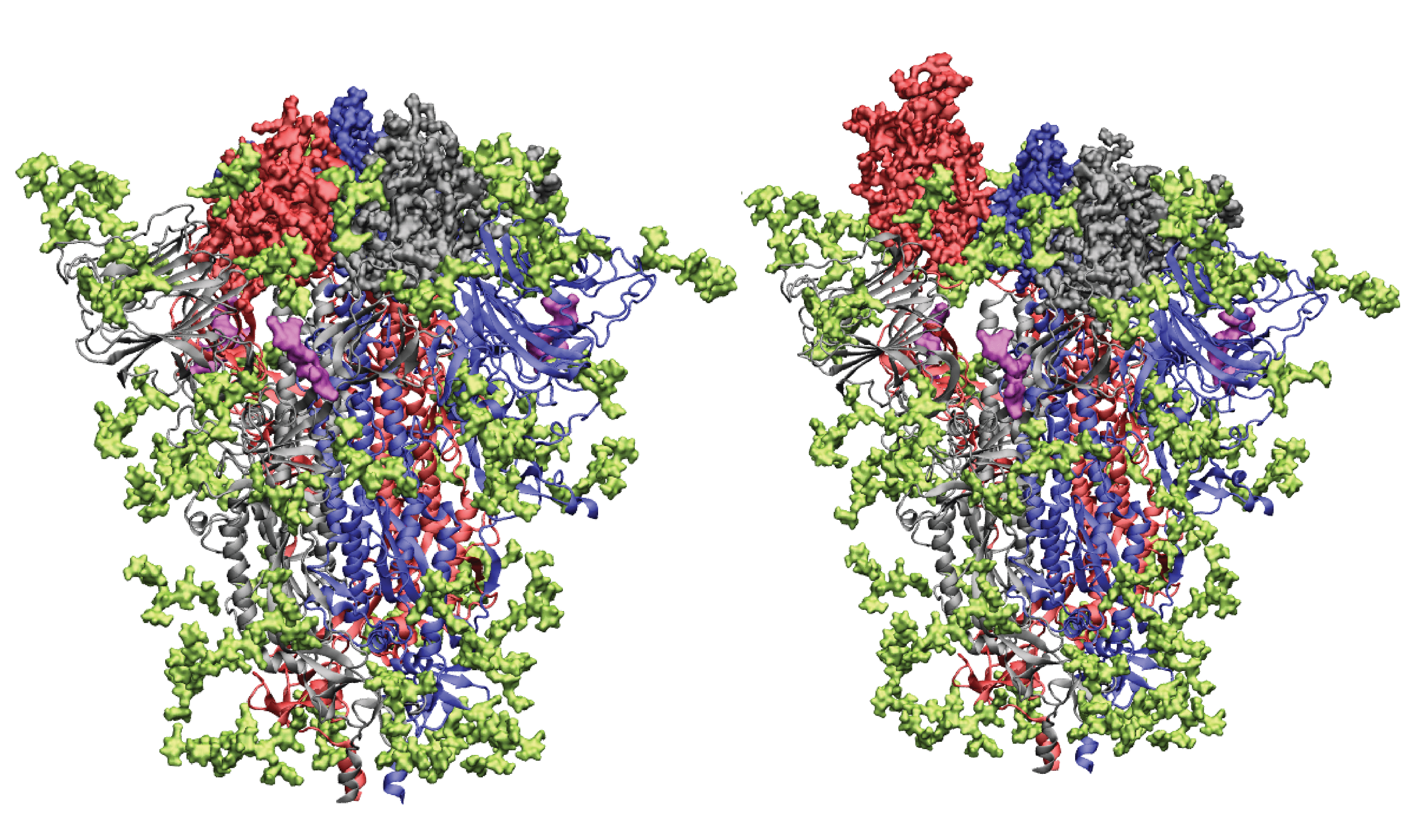
The SARS-CoV-2 S protein is responsible for binding to the human receptor ACE2 and initiating the infection process. To do so, it must first transition from a down, non-infectious state to an up one that exposes its receptor-binding domain. In our previous allocation on Summit, we determined the role of covalently attached glycans that form a so-called "glycan shield", which also contributes to immune system evasion. We computed two-dimensional (2D) potentials of mean force (PMFs) for opening of the glycosylated and un-glycosylated spike, as well as the opening pathways between the two states. We showed that the energy barrier between the down and up states is higher with the glycans and explained it by showing how protein-glycan interactions stabilize both the down and up states along the path. Now, in order to respond to the reviewers of our manuscript submitted to Communications Biology, we propose to run additional PMF calculations on Summit in order to expand the range of the conformational space explored. In particular, we will determine precisely how broad the up state of the S protein is and compare it to predictions from enhanced sampling simulations by others.
Results (0)
PI
James Gumbart; Georgia Institute of Technology