Dynamics of SARS-CoV2 spike protein RBD and core S2 domains
Completed project
Abstract
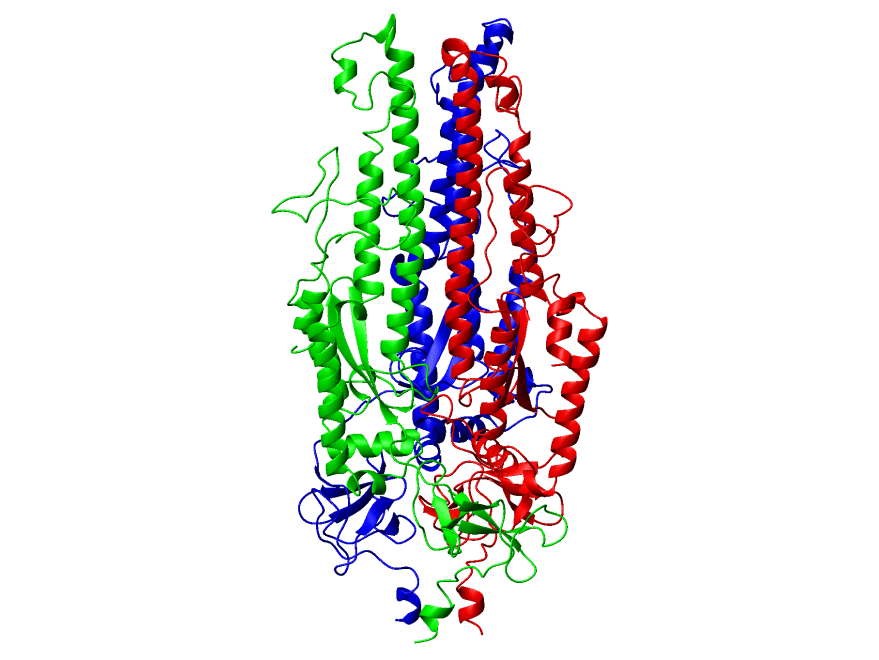
Current pandemic caused by the novel SARS-CoV-2 virus is disrupting economies and the daily lives of humans across the globe. To develop effective therapies against this virus, it is imperative to glean critical insights into the molecular mechanisms behind the highly virulent nature of this pathogen. SARS-CoV-2 virus uses its surface-exposed spike protein S-trimers to bind to the human angiotensin-converting enzyme 2 (ACE2) receptor found on epithelial cell surfaces, and this binding event initiates S-trimer conformational changes that lead to virus-cell membrane fusions. Prerequisites for fusion with host cell membrane are among others (i) conformational changes of at least one receptor binding domain (RBD) of the S-trimer from the down/closed into up/open conformation, (ii) priming of the S-proteins in the trimer by cleavage of S into S1 and S2 and further cleavage of S2 at the S2’ position. RBD conformational change into the up form is required for ACE2 binding and priming of the S-protein is required to enable the detachment of S1 from the core helices and fusion peptides. After the detachment and removal of the core surrounding S1 part of S, the core helices have the space to change their conformations into an elongated helix bundle and initiate fusion with host cell membrane. Here we propose to study in detail the conformational changes of the RBD from the down into up conformation and the conformational changes of the exposed S2 core part into the elongated helix bundle by performing atomistic molecular dynamic simulations.
Results (0)
PI
Numan Oezguen; Baylor College of Medicine